Red Wing Shoe Company recently launched a new work boot with an unusual claim at the heart of its campaign: "Measured 3 million times, cut once." It's a bold line. It's also true — and the data behind it came from Volumental.
The IronFlex is Red Wing's SS26 foundational product: a medium-duty work boot designed for tradesworkers across construction, electrical, plumbing, and carpentry. What makes it different from most product launches isn't the BOA closure system, the waterproofing, or the Welt-to-Cement construction — though all of those matter. What makes it different is how it was designed.
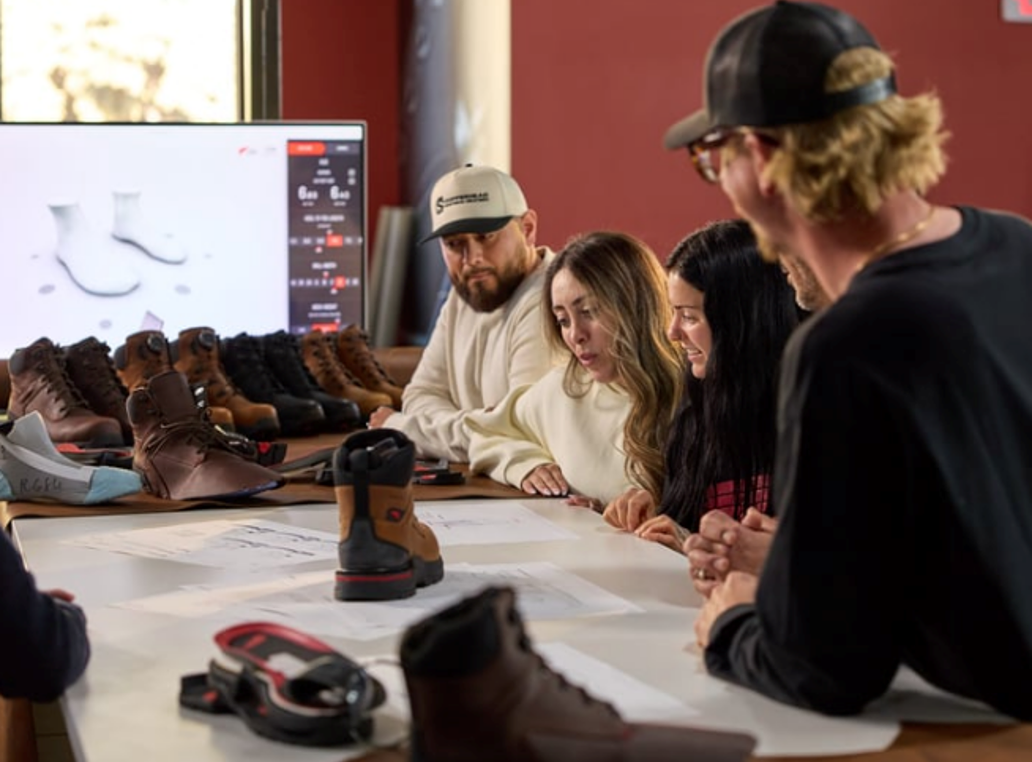
For the first time, Red Wing used 3D foot scan data as a core input into the product development process. And we were there for it.
From Point of Sale to Point of Origin
The conventional role of foot scanning technology in retail is well established: a customer steps onto a scanner, gets a measurement, and receives a size recommendation. It's useful. It reduces returns, improves confidence, and drives conversion. We've seen those results replicated across thousands of stores.
But there's a question that rarely gets asked: what if the data collected in those scans fed back into how the product was made in the first place?
That's the question Red Wing started asking about two years ago, as they began development on what would become the IronFlex. Their product team reached out to Ales Jurca, Volumental's VP of Footwear Research (author of the peer-reviewed analysis of 1.2 million foot scans published in Scientific Reports), to explore exactly that.
What made the conversation immediately compelling was the nature of the dataset. Volumental scanners have been deployed across more than 500 Red Wing stores for years. Every tradesworker who walked in to find a better-fitting boot contributed a data point — adding up, over time, to 3 million foot scans. Not from a recruited research panel. Not from a general population study. Not from athletes or lifestyle consumers. From Red Wing's own customers: the electricians, plumbers, masons, construction workers, and HVAC technicians who buy work boots because they spend eight to ten hours a day on their feet and cannot afford a poor fit.
"This is a dataset with no equivalent in the industry. It captures the actual foot geometry of the specific population a work boot brand is trying to serve — collected in the context of buying work boots, at the moment those customers were most motivated to articulate what fit means to them."
— Ales Jurca, VP of Footwear Research, Volumental
That distinction matters enormously when you start using the data for product development.
What the Data Actually Did
The starting point was Red Wing's existing 601 last — the foundation of the Tradesman family. In shoe manufacturing, a last is the mechanical mold around which a boot is built; modifying it is a consequential decision that sets the shape of every size in the run. The goal was to adapt the 601 specifically for the IronFlex's target wearer: a medium-duty tradesworker who spends long hours on their feet, kneels frequently, and needs a boot that performs across demanding environments.
Ales Jurca and the product team used the scan database to map the actual shape distribution of that wearer population in granular detail. What do the ball girths of these customers' feet actually measure — not on average, but across the full distribution? Where does the instep sit relative to traditional last assumptions? How does foot geometry vary across the size run in ways that standard grading conventions don't account for?
These are questions that footwear development has historically answered with educated guesswork, accumulated craft knowledge, and the instincts of experienced pattern makers. All of that expertise matters — but it has always operated without a precise picture of what the customer's foot actually looks like at scale. The scan database changed that.
The analysis pointed to a specific answer: the 601 last needed volume added at the waist and instep to better match the foot shapes of Red Wing's actual customers. The net effect of that modification — a toe box that feels roomier without changing the external dimensions of the boot — is exactly the kind of outcome that is invisible on a spec sheet but immediately apparent to someone who puts the boot on before a long shift. It required over 1,000 micro-adjustments to arrive at, each one grounded in measurement rather than convention.
The same dataset also informed how wear testers were recruited: not by self-reported shoe size, but by matching actual scan geometry to the intended last specifications at both the sample size and the extremes of the size run. This ensured that feedback from wear testing was structurally valid — coming from people whose feet were genuinely representative of the target population, not whoever happened to be available.
The Outcome: 50% Better Fit Satisfaction
Red Wing's wear tester feedback quantifies the result directly: a 50% improvement in fit satisfaction through data-driven design — the direct outcome of building a boot around the actual foot shapes of the people who will wear it.
That number reflects the difference between designing for an assumed population and designing for a measured one. When you know what your customer's foot actually looks like — because 3 million of them have been scanned in your stores — the product decisions that follow are different, and the fit that results is demonstrably better.
"IronFlex — Built from the scans of 3 million workers like you."
— Red Wing Shoe Company, IronFlex launch campaign
That line appears on Red Wing's in-store Volumental scanners across North America today. It is not a marketing flourish. It is a description of the process.
What This Means for the Rest of the Industry
The IronFlex story is notable not just because of what it achieved, but because of what it signals.
Foot scanning has been deployed at scale across the footwear retail industry for years. The data exists. What has largely been missing is the pipeline to take that data upstream — out of the recommendation engine and into the product design process where it can inform decisions about lasts, grading, volume distribution, and wear testing methodology.
That pipeline now has a working proof of concept.
For footwear brands, the implications are significant. Most scan programmes are currently generating data that informs a single moment in the customer journey: the fitting. But that same data, aggregated and analysed at scale, contains a detailed picture of how your specific customer's foot actually differs from the assumptions built into your current lasts — assumptions that may be decades old.
The gap between what your customer's foot looks like and what your product is built for is measurable. And once it's measurable, it's fixable.