Why this matters
Foot shape and size are not static. Movement, load, and activity can all influence how the foot behaves. For footwear fitting, injury prevention, and performance, it is essential that measurement technology delivers consistent results, even when scanning conditions vary.
This study addresses a key question: can the Volumental 3D foot scanner be trusted to produce stable measurements before and after moderate physical activity?
It also builds on earlier peer-reviewed research using Volumental scan data, including an analysis of 1.2 million foot scans published in Scientific Reports (Jurca et al., 2019) and a study of footwear fit across 90,000+ scans presented at 3DBODY.TECH 2021.
About the study
The purpose of the study was to assess the reliability of the Volumental foot scan app and scanner before and after a 30-minute jog.
Twenty adult participants completed two testing sessions. In each session:
- Feet were scanned using the Volumental 3D scanner before jogging
- Participants completed a 30-minute self-paced jog on a predefined route
- Feet were scanned again immediately after the run
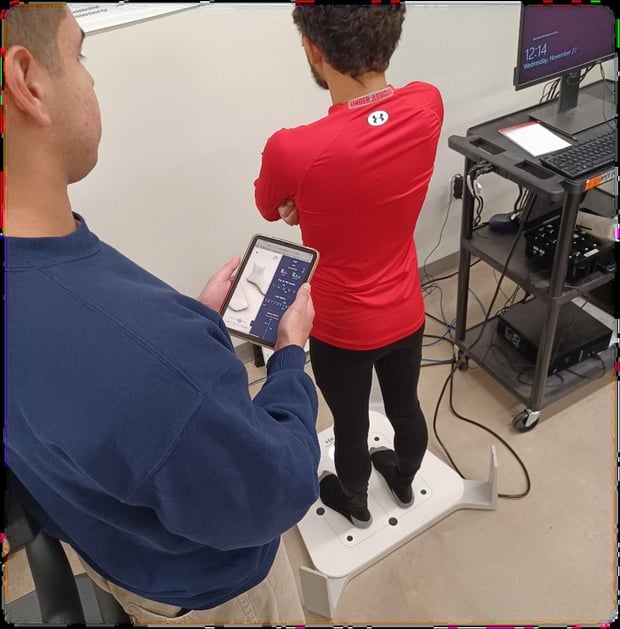
A participant is scanned during the study. Photo: Tamayo & Smith, Texas A&M University–San Antonio.
Six foot dimensions were analyzed:
- Foot length
- Ball width
- Girth
- Heel width
- Instep height
- Instep girth
Statistical analysis focused on identifying differences between pre- and post-run scans, between left and right feet, and across repeated trials. Measurement reliability was assessed using intraclass reliability (Cronbach’s Alpha).
Key findings
The study found no statistically significant differences between pre-run and post-run measurements for:
- Foot length
- Ball width
- Girth
- Instep height
- Instep girth

Heel width across trials: values stayed stable from pre-run to post-run on both testing days. Source: study poster.
A statistically significant difference was observed between left and right heel width, with the left heel being approximately 3 mm narrower. This difference was consistent across trials and was most likely not caused by jogging.
Most importantly, measurement reliability was excellent across all dimensions, with reliability scores above 0.90 for every measure. This indicates very high consistency between repeated scans.
What this means for footwear fitting
The results show that the Volumental 3D foot scanner produces stable and repeatable measurements, even after moderate physical activity. This is particularly relevant for real-world environments such as:
- Running and specialty footwear stores
- Sports performance settings
- Clinical and orthotic assessments
Customers and professionals can rely on the scan results as a consistent foundation for size, fit, and product recommendations.
Limitations and next steps
The study had several limitations related to participant monitoring and standardization. Participants were not observed during their jog, so some may have taken breaks despite instructions not to. Warm-up routines were not standardized, which could have affected swelling or allowed some participants to exercise longer than the intended 30 minutes. Additionally, delays in returning for the second scan may have prevented the scanner from detecting changes in foot dimensions.
Future research could further validate the scanner by comparing its measurements to traditional gold-standard tools, such as digital or sliding calipers, to assess absolute accuracy.
Conclusion
This independent study confirms that the Volumental 3D foot scanner delivers highly reliable measurements across repeated scans and after physical activity. The findings support its use as a dependable measurement tool for footwear brands, retailers, athletes, and health professionals.
👉 Want to see what we could do for your brand? Check out our R&D services.
The same measurements make the scan usable well beyond shoe size. For how retailers apply it to insole and orthotic fitting, see our guide to foot scanning for insoles.
Citation: Tamayo, C. D., & Smith, J. D. (2025). Reliability of the Volumental 3D Foot Scanner Before and After Jogging. International Journal of Exercise Science: Conference Proceedings, 2(17), Article 149. Available at: digitalcommons.wku.edu/ijesab/vol2/iss17/149
Download the study here: Reliability of the Volumental 3D Foot Scanner Before and After Jogging

.png?width=1920&name=TRE%20-%20post%20(7).png)